Transfer between sensor layouts
OpenTac-Transfer (opentac.transfer) maps a calibrated normal-force distribution from one sensor layout to another using their physical geometry. The sensors can differ in outline, taxel pitch and taxel count. This supports reuse of recorded or simulated contact data across layouts, subject to assumptions about spatial resolution, calibration and contact placement.
from opentac import manifest
from opentac.transfer import transfer

a = manifest.load("skin_a.json")
b = manifest.load("skin_b.json")
frame_b = transfer(frame_a, a, b)      # frame_a in newtons per taxel
examples/transfer.py simulates a press on a 4 mm skin, transfers it to a
2.5 mm skin, and compares it with the same press simulated on that skin.
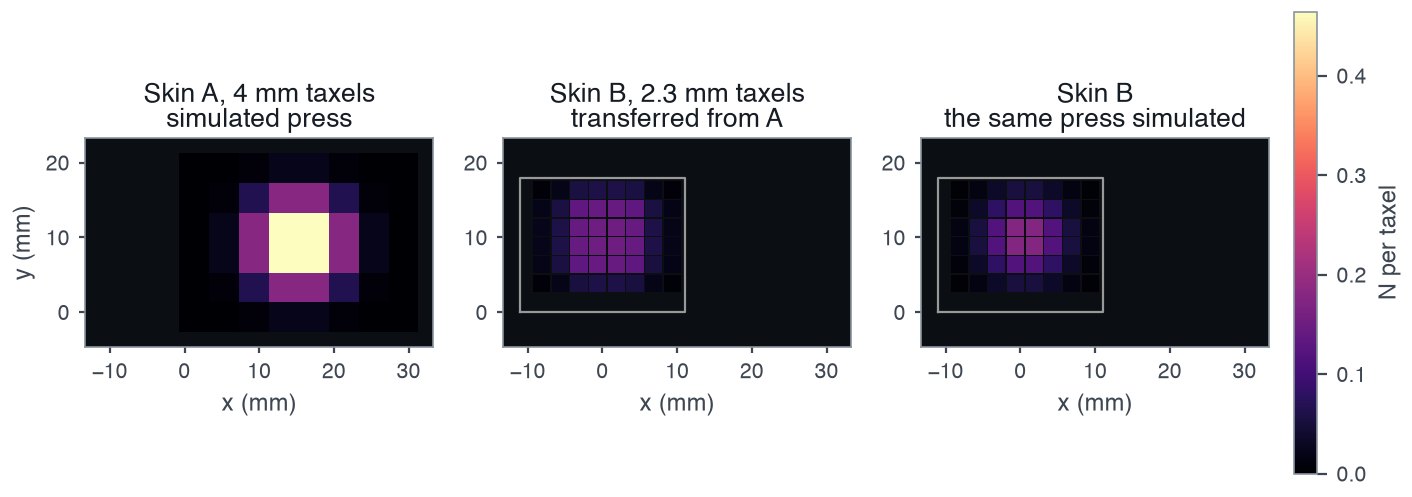
examples/transfer.py: a 10 mm ball at 3 N simulated on skin A (4 mm pitch), its transfer onto skin B (2.5 mm pitch), and the same press simulated on B. Each taxel shows the newtons on its own area, so B's smaller taxels read less each.Input data and placement
frame: aFramefrom skin A in newtons per taxel (units == "N"). ADC-count frames are rejected because the resampling operation sums force contributions. Convert counts with the source sensor's calibration first. Unread taxels (NaN) are treated as zero.a,b: the two skins' manifests (aManifest, a manifest.json path, a design .zip, or a dict). Each skin's taxels must sit on one square grid; the two grids can have different pitches.center=True(default): the contact's centre of pressure goes to the centroid of B's taxels, or totarget=(x, y)in B's millimetres. The centre uses only taxels above 10 % of the frame's peak, so noise does not pull it.center=False: A's millimetres are used as B's, moved byshift_mm.angle_deg: turn the contact by this angle.kernel:"box"(default) or"tent"(smoother when B is finer than A).
Output and force conservation
A Frame on B: newtons per taxel in B's pixels order, units == "N", the
input's t. imu is left empty, because it described A's board.
The resampling conserves force when the contribution outside the target is
accounted for: force assigned to B plus force outside B equals the force on A. To see the lost part, or to apply one placement to many frames, use
Transfer directly:
from opentac.transfer import Transfer

tr = Transfer.centered(a, b, frame_a.taxels)   # or Transfer(a, b, angle_deg=..., shift_mm=...)
fb = tr.force(frames_a)                        # (n_frames, n_A) -> (n_frames, n_B), N
tr.lost(frame_a.taxels)                        # N that landed outside B's taxels
Resample in physical coordinates
The transfer model assigns each taxel a square cell, centred on the taxel and one pitch wide. It treats the measured force as uniformly distributed over that cell. This piecewise-constant pressure approximation provides the basis for resampling in physical coordinates:
- Place A on B. Rotate A's taxel positions by
angle_deg, then shift them, so the contact sits where you want it on B. - Resample by area. Cut each A cell into small sub-cells, each carrying an
equal share of that taxel's force. Each share goes to the B cell it lands
in. This is one fixed matrix per placement:
F_B = M @ F_A. - Drop what B cannot see. Shares that land outside B's taxels (past the
outline, or in a gap) are dropped and counted in
lost().
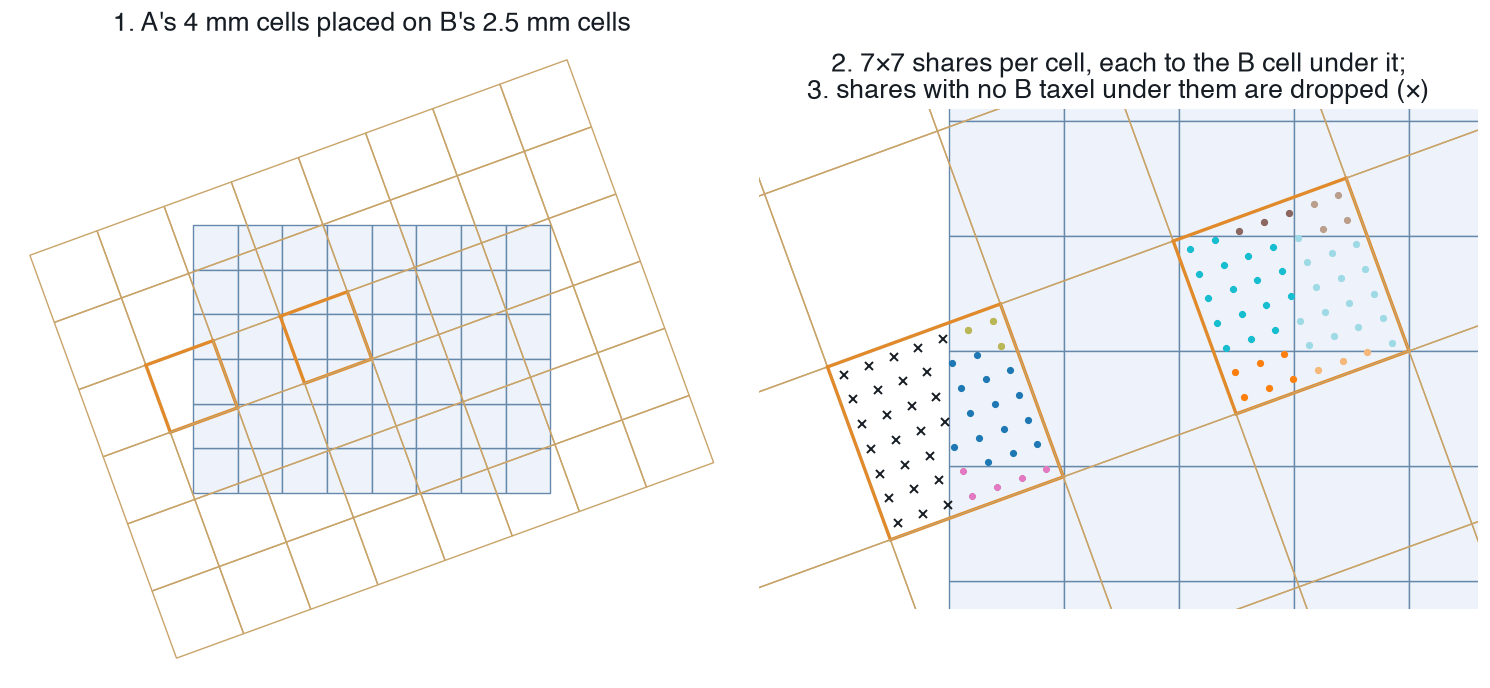
examples/transfer.py, with A turned 20°. The share points are the ones Transfer bins; of the cell over B's edge, 47% lands on B.Evaluation and limitations
The paper evaluates transfer using hand-applied contacts on four skins with 409, 502, 96 and 174 taxels, at 2.0 and 4.0 mm pitch. Five objects were evaluated at forces from 1 to 8 N. Every method was given the target contact pose. Shape F1 compares thresholded contact regions, using approximately one quarter of each frame's peak; it evaluates contact shape and location rather than force-magnitude accuracy.
| predicting skin B's frame from | median shape F1 | frames |
|---|---|---|
| another press on skin B itself (repeatability limit) | 0.80 | 1857 |
skin A, with opentac.transfer |
0.75 | 5290 |
| the same, scored only where A covers B | 0.79 | 5286 |
| skin A's counts, area-averaged onto B (no calibration) | 0.71 | 5291 |
| skin A's counts, stretched by row and column (no manifest) | 0.63 | 5077 |
Contact shape and spatial extent. In a separate demo, three objects were pressed freehand on skins of 4.2, 3.1 and 2.0 mm pitch. An allen key read 10.3, 9.7 and 9.5 mm wide on the three.
The mapping has several limitations:
- Detail finer than A's taxels. Resampling a 4 mm grid onto a 2 mm grid cannot recover
structure below the source resolution. The
"tent"kernel smooths the result. - Contact area at coarse resolution. A partly covered taxel reports its whole area. In the demo, the 4.2 mm skin read 28–54 % more contact area than the 2.0 mm skin for the same object (tape roll: 1504 against 976 mm²). Transfer cannot recover the unresolved contact boundary within a coarse source cell.
- Uncalibrated signal magnitude. The same objects peaked at about 200 counts per mm² on the 4.2 mm skin and 620–780 on the 2.0 mm skin. Counts depend on the design and the velostat, which is why transfer works in newtons.
- Saturation. A taxel that hit the ADC maximum on A is a lower bound, and stays one on B.
- Contact placement. The mapping does not infer the object's target pose. It centres the contact unless you give a target, shift or angle.